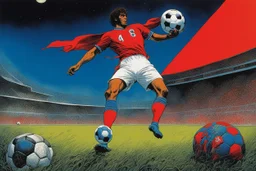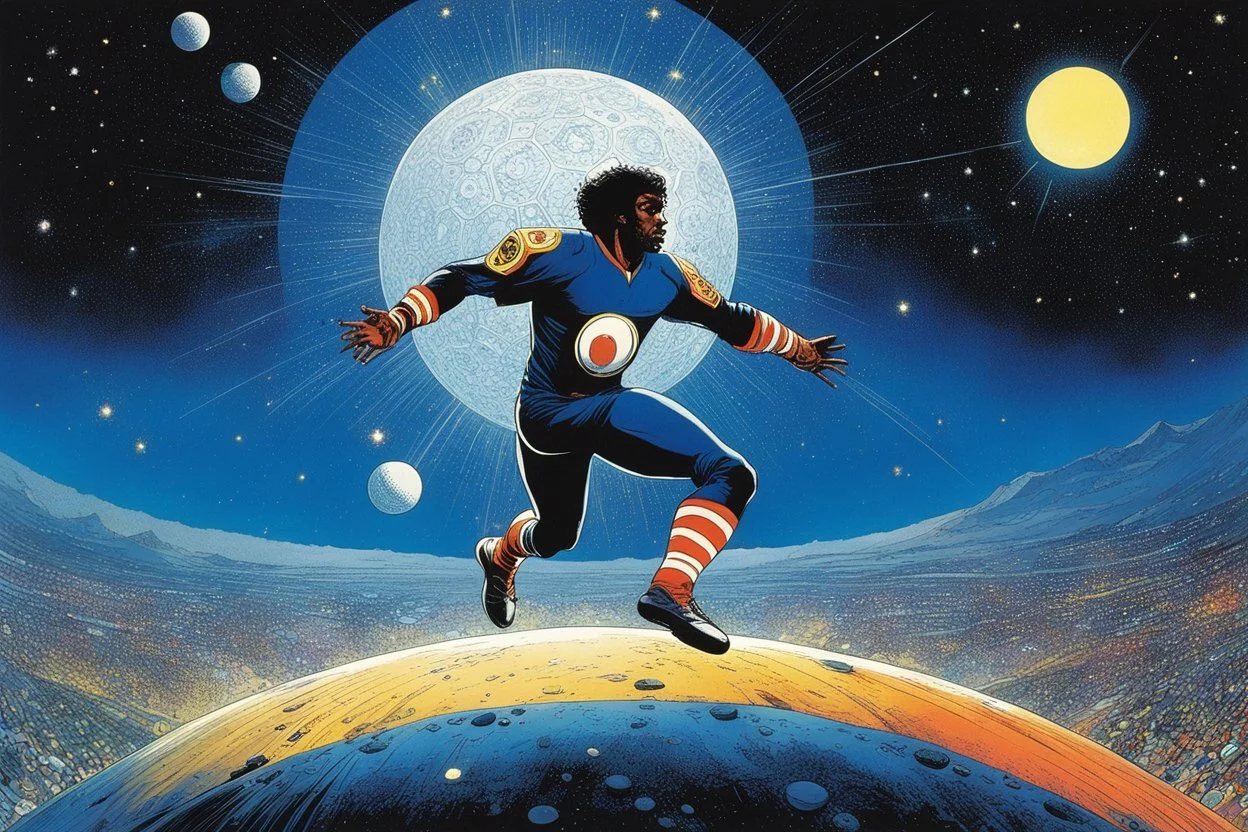
Placeholder: Ah, the football player of the Redemption (art by Philippe Druillet's Délirius, 1973, written by Jacques Lob), a dynamic and surreal athlete on the ethereal pitch of the mondial, surrounded by the vast expanse of space, dancing among the shimmering stars. Ah, the football player of the Redemption (art by Philippe Druillet's Délirius, 1973, written by Jacques Lob), a dynamic and surreal athlete on the ethereal pitch of the mondial, surrounded by the vast expanse of space, dancing among the shimmering stars.

@generalpha

Prompt

Ah, the football player of the Redemption (art by Philippe Druillet's Délirius, 1973, written by Jacques Lob), a dynamic and surreal athlete on the ethereal pitch of the mondial, surrounded by the vast expanse of space, dancing among the shimmering stars.

distorted image, malformed body, malformed fingers

3 months ago

Generate Similar

Explore Similar

Model

SSD-1B

Guidance Scale

7

Dimensions

1248 × 832

Similar
the soccer player of the Red Redemption: (art by Philippe Druillet's Délirius, 1973, written by Jacques Lob) Lone Sloane: laying surreal ethereal football mondial
(in the style of Orion, by Masamune Shirow) Hooray for captain Spaulding the African explorer Hooray hooray hooray Ernst and peter max
One of the greatest single issues of all time - and for good reason! This is a milestone classic in the history of comics, because it showed the awesome scope of Jack Kirby's cosmic vision and imagination. New Gods #7 features the start of the Eternal War between New Genesis and Apokolips, gives us the origin story of Highfather, tells us of how Orion and Mister Miracle came to be as they are, and showed us the early twisted machination of Darkseid. This is a tour de force comic, so much so, tha
[Philippe Caza] David Bowie: This is Ground Control to Major Tom, You've really made the grade, And the papers want to know whose shirts you wear, Now it's time to leave the capsule if you dare, This is Major Tom to Ground Control, I'm stepping through the door, And I'm floating in a most peculiar way, And the stars look very different today
[art by Philippe Druillet] I want to break free, I want to break free I want to break free from your lies You're so self-satisfied I don't need you I've got to break free God knows, God knows I want to break free
the soccer player of the Red Redemption: (art by Philippe Druillet's Délirius, 1973, written by Jacques Lob) dynamic player surreal ethereal football mondial
[art by Marcel Gottlieb, dit Gotlib] a Licensed space jockey in action
[art by Dorohedoro] Jesus as he found himself in a desert spaceship adorned with space helmets and Christmas decorations. His skin glistened with moisture, a celestial sheen reflecting the enigmatic allure of the punk band with spiky hair and lizard heads. Alligator wings fluttered in the artificial breeze, a symphony of strangeness echoing through the spaceship. a mystical aquarium teeming with life behind glass guitars. The juxtaposition of elements—Mayan feathers, beads, rope on hands—created
Who can forget that 1960's TV show from Toho studios. The Space Giants, along with the heroes of the Science Foundation, who weekly saved the planet from space monsters. Being a childhood fan of Ultra Man, I really enjoyed Bing creating these pictures, and it did so well.
(in the style of Orion, by Masamune Shirow) ((heavy metal / metal hurlant: psychedelic) In a desert landscape straight out of a paranoid 1970s underground comic, under a sky pulsating with impossible green and purple cosmic dust, Cheech and Chong are captured by a lens smeared with hallucinatory residue, building a rocket. This is not NASA. This is their rocket. It's constructed from salvaged metal drums, rusty chrome, countless 'UP IN SMOKE' signs, empty bong bowls, and a nose cone made from a
Patrick Dupond as a celestial dancer in space, vintage 1970's photo
A conscious machine In the space, in a spaceship, with a computer: Destination: Void is a science fiction novel by American author Frank Herbert, the first of four novels in the Pandora Sequence series. It first appeared in Galaxy Magazine—illustrated by John Giunta—in August 1965, under the title Do I Wake or Dream?, but was published in book form as Destination: Void the following year. A revised edition, edited and updated by the author, was released in 1978. The book stands alone but the sto

© 2026 Stablecog, Inc.